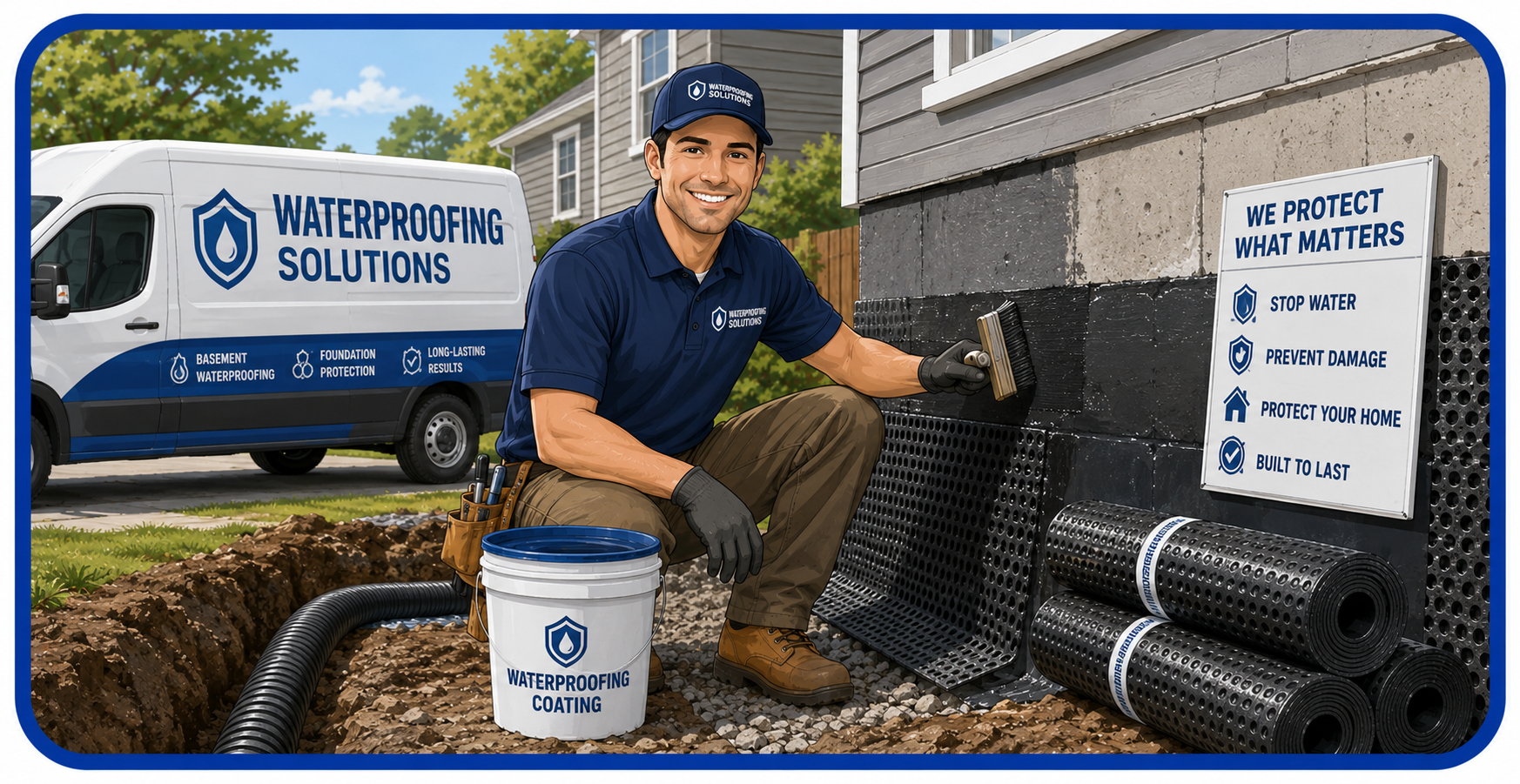
Perimeter channel systems that capture and redirect water at the point of entry, protecting your basement without exterior excavation or landscape disruption.
Effective, proven, and installed without disturbing your yard or exterior features.
Interior systems are installed entirely from inside the basement, eliminating the landscaping and hardscaping disruption that exterior work requires.
Rather than waiting for water to accumulate, channel systems intercept it at the point of entry for immediate collection and removal.
Regardless of outdoor temperature or ground conditions, interior drainage installation moves forward on schedule.
Gravity-fed channel designs minimize pump cycling frequency, extending pump service life and reducing electricity usage.

An interior drainage system addresses basement moisture by capturing and redirecting groundwater after it has entered the building envelope at the floor-wall joint or through weep holes at the base of the foundation wall. This differs fundamentally from exterior waterproofing, which prevents water from reaching the wall surface. Interior drainage accepts that water will enter under certain pressure conditions and provides a managed pathway for that water to reach a collection point without spreading across the basement floor or damaging finished materials. For Whitesburg homes where exterior excavation is impractical, cost-prohibitive, or where the moisture entry is concentrated at the perimeter footing level, interior drainage is the technically appropriate solution.
Perforated channel systems offer specific advantages over simple gravel-and-pipe installations in Whitesburg basements with block or stone foundations. The channel profile is engineered to sit at the footing level where hydrostatic pressure concentrates, and the wall flange extension captures seepage that occurs at the bottom course of block rather than strictly at the floor-wall joint. This distinction matters because without the wall flange, water running down the interior wall face bypasses the channel and spreads across the floor before reaching the collection point. Proper channel specification requires understanding where the moisture entry is actually occurring, which the assessment process documents before any installation begins.
Sump pit sizing for an interior drainage system in Whitesburg requires calculating the expected inflow volume per pump cycle to determine the minimum useful pit capacity. A pit that is too small forces rapid pump cycling, which increases motor wear and reduces system reliability. Our pit specifications for Whitesburg installations account for the channel length feeding the pit, the soil permeability documented during the assessment, and the seasonal inflow patterns typical for your area of Whitesburg, KY. These calculations are not guesswork; they are based on the same hydraulic principles used in commercial drainage design, applied to residential scale.
One of the most important honest assessments we provide in Whitesburg is explaining what interior drainage does not do. Interior systems do not treat the foundation wall itself, do not reduce hydrostatic pressure against the exterior wall surface, and do not address wall seepage that is occurring mid-wall due to horizontal cracks or structural movement. For those conditions, exterior membrane work or crack injection is the appropriate treatment. Interior drainage excels at managing water entry at the footing level, floor-wall joint seepage, and floor-level pressure seepage in situations where the foundation is structurally sound but the original waterproofing has aged or the perimeter soil conditions create chronic seepage during saturation events. We document which conditions are present in your specific Whitesburg basement and recommend the approach that addresses your actual moisture source, not a generic solution that covers all scenarios on paper but misses your specific entry points.
From perimeter channel installation to sump integration and annual service, a complete interior drainage solution.
Our full perimeter systems capture seepage from every wall section, routing it to the sump pit regardless of which foundation wall is experiencing the greatest inflow at any given time.
Learn moreWe document which walls show active moisture evidence and design targeted channel runs that address the documented entry points without over-specifying scope.
Get an assessmentBlock and stone foundations in older Whitesburg homes commonly show mid-wall seepage that bypasses floor-level channels without the wall flange extension. We specify this component when the assessment shows wall-face moisture migration.
Ask about wall flangesInstalling a new pit or relocating an existing one to optimize channel routing geometry and pump efficiency. Proper pit placement is the key to gravity-assisted drainage performance.
Plan your pit locationExisting interior drainage channels can become clogged with sediment, mineral deposits, or root intrusion over time. We inspect, flush, and repair existing systems in Whitesburg homes to restore full drainage performance.
Schedule an inspectionWhen a previously installed partial channel system needs to be extended to address additional wall sections, we design and install the expansion with clean transitions to the existing channel and updated sump pit capacity if required.
Expand your systemFour stages from assessment to operational system, each one documented and verified before the next begins.
We inspect the basement under controlled conditions to document exactly where and how water is entering your Whitesburg home. We look for staining patterns, efflorescence location, floor-joint seepage evidence, and any wall-face moisture migration. This documentation determines the channel scope and routing.
Cut dimensions are verified before the gravel bed is placed to confirm the channel profile will sit at the correct elevation relative to the footing.
Gravel bed placement, drainage channel positioning, wall flange installation where specified, and sump pit connection are completed in sequence. Channel slope is verified with a level to confirm gravity-assisted flow toward the pit throughout the entire system.
Written completion documentation is provided at handoff, including channel routing dimensions, pit specifications, and pump information for future reference.
The results our Whitesburg clients experience speak clearly.
The assessment was thorough and they explained exactly which wall sections were causing the problem. The installation took one day and the crew cleaned up completely before leaving. The following spring, which was wet, produced zero water on the basement floor for the first time in seven years.
Our older block foundation was not a candidate for exterior work without major landscaping disruption. The interior channel system gave us the protection we needed without touching the exterior at all. The wall flange detail they added captured the seepage that was running down the bottom block course, which was the main issue.
The channel routing around our finished laundry room was handled cleanly. You cannot see where the channel runs under the new concrete. Professional work throughout.
Clear, direct answers from a drainage technician perspective, not a sales script.
The specific installation procedure varies slightly based on foundation type, existing slab thickness, and moisture entry pattern. Block foundations may require weep holes drilled at the base of the block to allow water trapped in the hollow cores to drain into the channel. Poured concrete foundations with floor-joint seepage are typically addressed with the channel profile alone. Our installation crew documents the method used for each wall section and provides this information at project completion.
The functional lifespan of an interior drainage system is largely determined by the durability of the channel material and the ongoing performance of the sump pump that removes the collected water. The channel installation itself is a permanent modification to the basement floor structure. The pump requires regular testing and periodic replacement, typically every 7 to 10 years. An interior drainage system that is properly maintained in a Whitesburg home can provide effective moisture management indefinitely.
We provide detailed written proposals for assessed conditions rather than phone quotes because every basement is different. We also explain whether the moisture pattern we observe is better addressed by interior drainage, exterior treatment, or a combination. Homeowners who understand the reasoning behind the recommendation make better investment decisions than those who receive a price without context.
The concrete cap poured at the end of the installation day requires 24 to 48 hours of cure time before the basement is fully returned to normal use. We advise homeowners on what activities can resume before full cure and what should wait. The sump pump is tested and operational before the crew leaves, so water management begins immediately even while the concrete finishes curing.
We offer annual drainage system inspection as part of our maintenance program in Whitesburg, which covers both the channel system condition and the sump pump. Catching issues like partial blockages or pump wear before they cause failure during a high-inflow event is the purpose of the inspection. Most homeowners find that scheduled annual service eliminates the reactive emergency calls that occur when a problem is discovered during a storm.
Interior drainage can be installed in a finished basement, though the process requires more planning and may involve temporary disruption of finished flooring and baseboard materials along the channel route. The saw-cutting must follow the perimeter regardless of what is installed above it, so finished flooring within the cut zone will need to be removed before work begins and replaced after the concrete cap cures. Drywall along the base of finished walls is typically removed at least partially to allow the wall flange to be installed properly. We document all disruption areas in the installation plan so homeowners can arrange for finish materials before scheduling the work.
Our certified drainage technicians serve Whitesburg and surrounding Whitesburg, KY communities. Call today for a free on-site assessment.
Call +1-866-476-1348 for Assessment